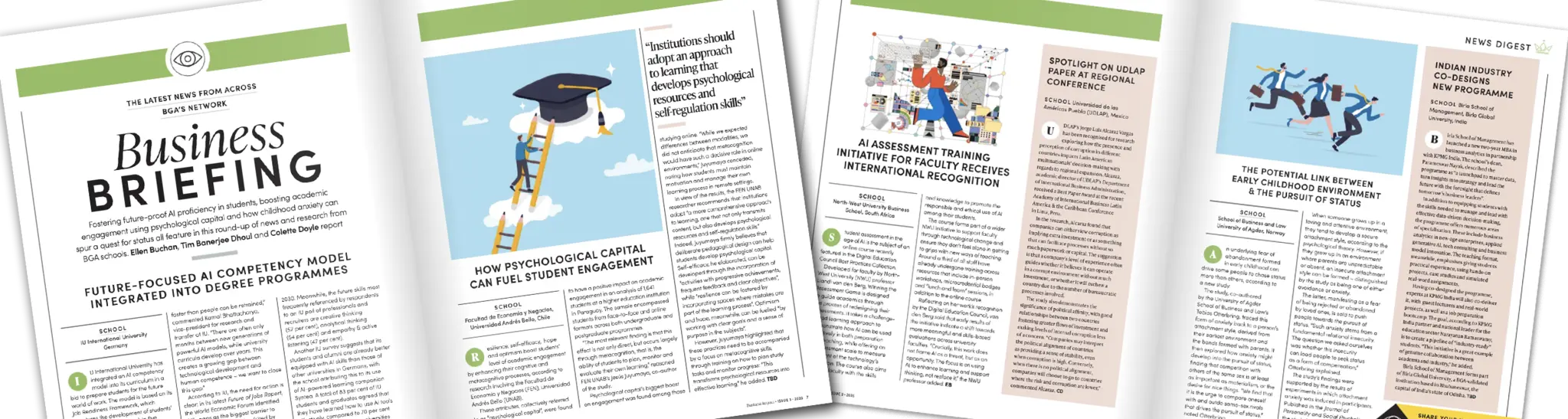


Explore all articles from Business Impact Magazine Volume 31, Issue 3.
Fostering future-proof AI proficiency in students, boosting academic engagement using psychological capital and how childhood anxiety can spur a quest for status all feature in this round-up of news and research from BGA schools.
Contributions from:

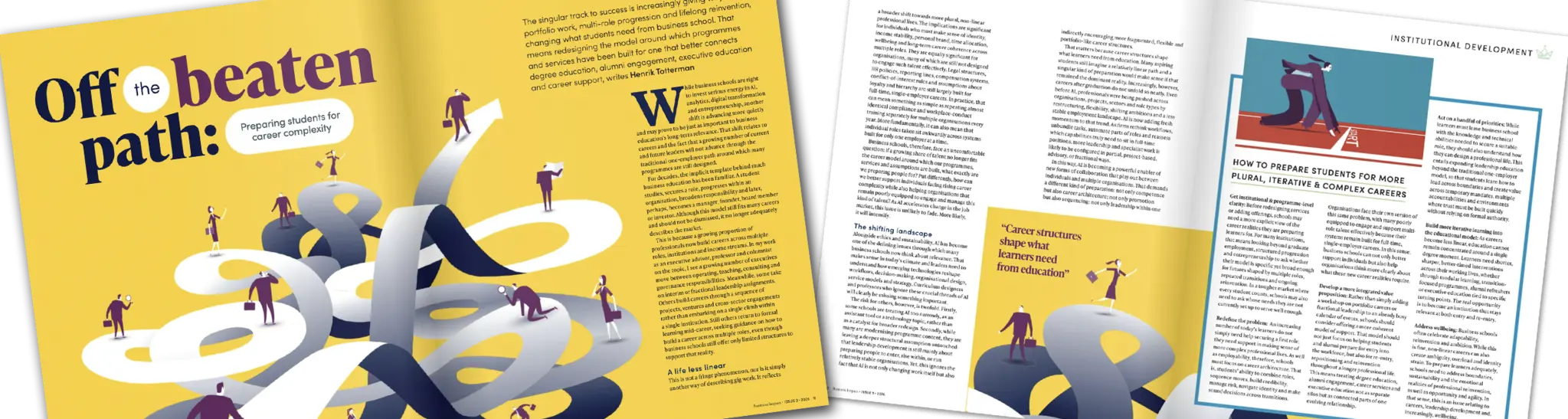
The singular track to success is increasingly giving way to portfolio work, multi-role progression and lifelong reinvention, changing what students need from business school. That means redesigning the model around which programmes and services have been built for one that better connects degree education, alumni engagement, executive education and career support, writes Henrik Totterman.
While business schools are right to invest serious energy in AI, analytics, digital transformation and entrepreneurship, another shift is advancing more quietly and may prove to be just as important to business education’s long-term relevance. That shift relates to careers and the fact that a growing number of current and future leaders will not advance through the traditional one-employer path around which many...

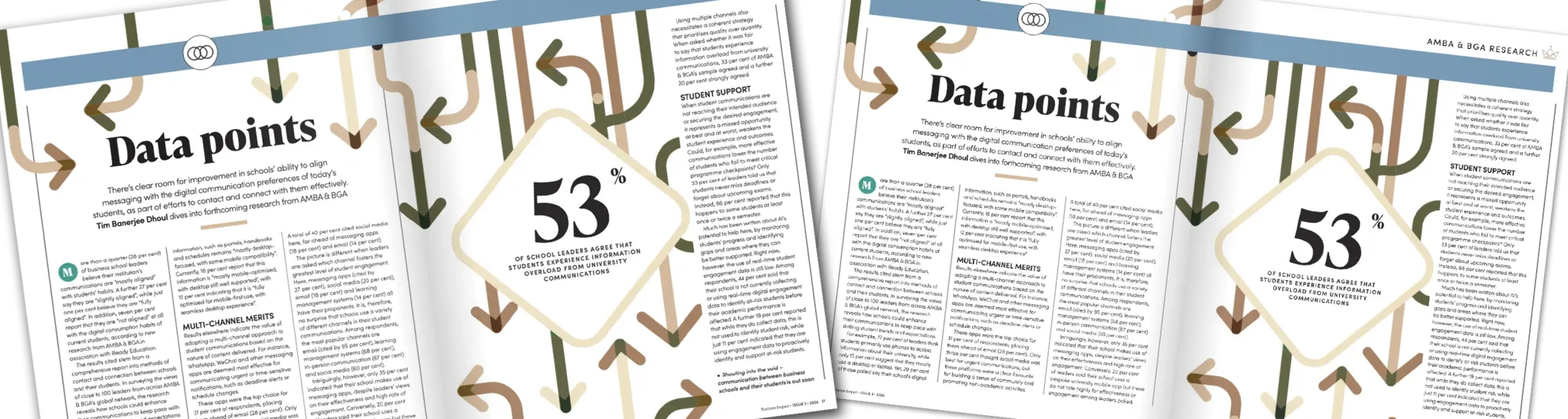
There’s clear room for improvement in schools’ ability to align messaging with the digital communication preferences of today’s students, as part of efforts to contact and connect with them effectively.
More than a quarter (28 per cent) of business school leaders believe their institution’s communications are “mostly aligned” with students’ habits. A further 27 per cent say they are “slightly aligned”, while just one per cent believe they are “fully aligned”. In addition, seven per cent report that they are “not aligned” at all with the digital consumption habits of current students, according to new research from AMBA & BGA in association with Ready Education. The results cited stem from a comprehensive report...

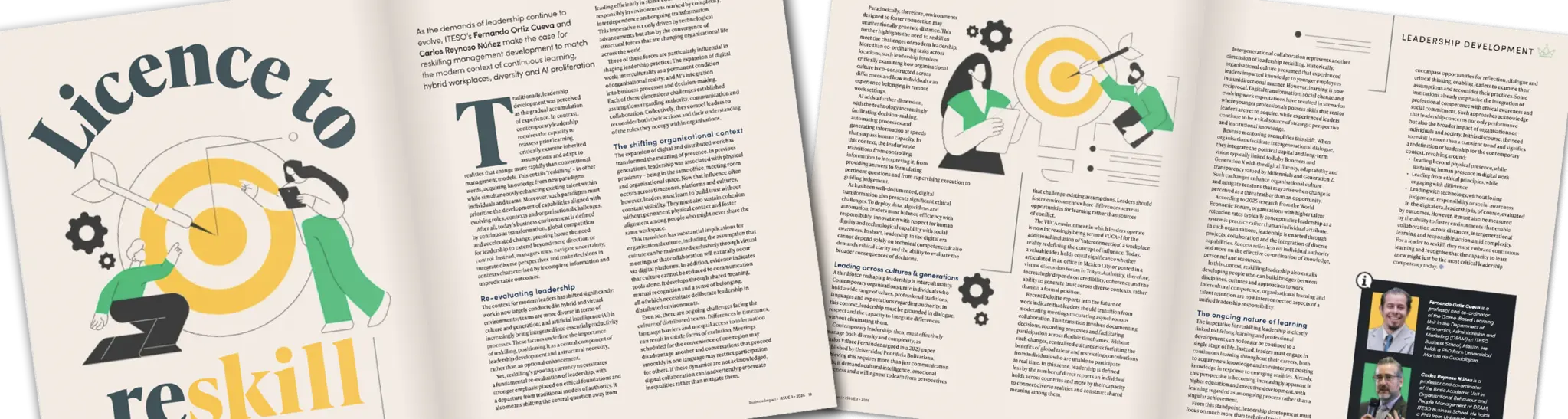
As the demands of leadership continue to evolve, ITESO’s Fernando Ortiz Cueva and Carlos Reynoso Núñez make the case for reskilling management development to match the modern context of continuous learning, hybrid workplaces, diversity and AI proliferation.
Traditionally, leadership development was perceived as the gradual accumulation of experience. In contrast, contemporary leadership requires the capacity to reassess prior learning, critically examine inherited assumptions and adapt to realities that change more rapidly than conventional management models. This entails ‘reskilling’ – in other words, acquiring knowledge from new paradigms while simultaneously enhancing...

Schools need to stop treating feedback as just another dashboard metric. True insight requires moving beyond data points to embrace open dialogue around the nuanced, lived experiences of their cohorts; the University of Bath School of Management’s Soheil Davari elaborates.
Universities are increasingly judged by numbers and student satisfaction surveys are at the centre of that shift. With scores feeding directly into league tables and rankings that determine institutional reputation, they influence how prospective students choose where to study and how universities present themselves to external audiences. In this context, student voice is often framed through these surveys in...

More than 170 community initiatives have been carried out by master’s and MBA students at Mannheim Business School through a long-established action learning component known as the Social Class Project. Here, Bettina Meltzer delves into the details of a recent project focused on supporting a tree-planting programme in the German state of Baden-Württemberg’s second-largest city.
The Social Class Project (SCP) is a core experiential element embedded across the Mannheim Business School’s flagship MBA, executive MBA and portfolio of master’s programmes. Designed to strengthen participants’ sense of social responsibility while fostering meaningful community engagement...

At Centrum PUCP in Peru, a new international summer exchange programme is seeking to bring the format into modern times, through its focus on generating lasting solutions for societal challenges and local communities. The programme’s creator, Fernanda Falcone Pino, provides the details.
For decades, exchange programmes have been one of the most visible expressions of internationalisation in higher education. They have broadened students’ global perspectives, strengthened intercultural competence and enriched learning beyond the classroom. Today, however, the international exchange is at a turning point: it must no longer be assessed primarily by destination, duration or the numbers

BoodleBox founder and CEO France Hoang outlines the importance of “AI fluency” and explains why multi-model AI, faculty trust and equitable access can reshape how business schools prepare tomorrow’s leaders

How would you describe BoodleBox and the problem it sets out to solve?
“BoodleBox is a collaborative AI platform built in partnership with higher education. We give every student, lecturer and employee secure access to more than 15 leading AI models – ChatGPT, Claude, Gemini, Mistral and others – in one environment designed for genuine collaboration between humans and AI. The problem...

While many institutions have placed diversity, equity and inclusion (DEI) at the heart of their agendas, formal strategies alone cannot nurture a truly inclusive environment. Instead, regular acts of allyship must be embedded into everyday practice, contends Poornima Luthra at Imperial Business School.
Organisations across the world have placed a firm focus on DEI; however, nurturing truly inclusive workplaces will not happen simply as the result of a diversity strategy or roadmap. That’s because inclusion is experienced in our day-to-day interactions with This means that each of us must see ourselves as others – both our colleagues and our leaders. This means...

INSEAD and HBS alumnus Johan Depraetere reflects on the value of travel, meditation and emotional honesty in his journey towards gaining self-awareness and becoming a more complete leader.
Early in my career, I was taught to lead from my head by developing analytical thinking, becoming an excellent problem-solver, mastering frameworks, projecting confidence and communicating effectively. And I feel grateful to have trained at some of the best places in this field: Harvard Business School, McKinsey, Goldman Sachs and Morgan Stanley. However, as I became more proficient in these areas, I grew aware of a gap that did not lie within the skills themselves, but in myself. The leaders...